
2026/9/20
How to Become a STEM Certified Teacher in 2027: Routes, Costs and Timelines
A practical comparison of the routes to STEM teacher certification — university endorsements, online STEM certification courses and association credentials such as STEM.org Certified Educational Instructor — with realistic costs, timelines and what reviewers actually check.
Ready to bring STEM into your own classroom?
AAES is the STEM.org authorised body for Asia. Earn the international educator certification in a two-day workshop — check the next cohort and seats.
"STEM certified teacher" means different things depending on who issues the credential. This guide separates the three routes that actually exist, what each one costs, how long it takes, and which evidence a reviewer looks at before your certificate is granted.
The three routes to STEM certification
1. State or ministry endorsement
In systems such as the United States, a STEM endorsement is added to an existing teaching licence through an approved university programme. It is the strongest credential inside that jurisdiction and close to worthless outside it, because recognition is tied to the issuing authority. Expect one to two years part-time and university tuition rates.
2. Online STEM certification courses
Universities, edtech platforms and foundations offer self-paced courses that end in a certificate of completion. They are fast and inexpensive, and they are the right tool for filling a specific gap — computational thinking, robotics, AI literacy. What they generally do not include is an external review of your teaching, which is why schools treat them as professional development rather than as a qualification.
3. Association certification with external review
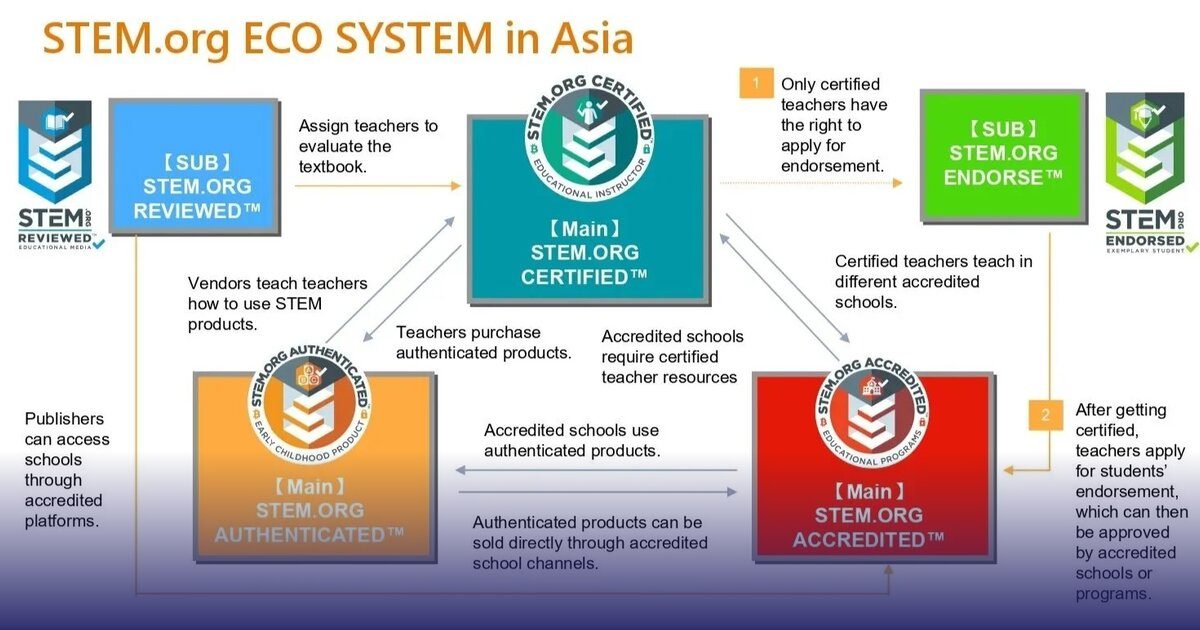
Professional bodies certify the teacher rather than the course. STEM.org Educational Research issues the Certified Educational Instructor credential, which AAES delivers across Asia-Pacific: candidates complete online modules, attend a twelve-hour in-person workshop, and submit their work for STEM.org review. The certificate carries a three-year validity period and is verifiable in a public registry — the two properties that make a credential portable between schools and countries.
What it costs and how long it takes
← 左右滑動查看完整對照 →| Route | Typical time | Typical cost | External review |
|---|---|---|---|
| State or ministry endorsement | 1–2 years | University tuition | Yes, by the authority |
| Online certification course | 4–40 hours | Free to a few hundred USD | Usually none |
| Association certification | 6–10 weeks | NT$25,000 for AAES Level 1 | Yes, by STEM.org |
The AAES Level 1 STEM Educator pathway runs online coursework first, then a single twelve-hour workshop day, then review. Most candidates finish inside a single cohort cycle rather than an academic year, which is the practical reason mid-career teachers choose it over a second degree.
What reviewers actually check
Reviewers are not scoring attendance. Three things decide the outcome:
- Evidence of classroom practice. Lesson plans that were taught, not lesson plans that were designed. Student artefacts matter more than slide decks.
- Integration, not addition. A STEM lesson is judged on whether science, technology, engineering and mathematics carry each other through one task, not on whether a robot appeared.
- Reflection. What failed in the lesson and what you changed. Submissions with no failure described are the ones most often returned.
Choosing between them
If you teach in one jurisdiction for the rest of your career, the state endorsement is the safest investment. If you teach internationally, move between schools, or need a credential a parent or employer can verify online, the association route is the one that travels. Online courses are the cheapest way to close a named skill gap and to build the evidence file the association route will ask for — they work best as a component of a plan, not as the plan.
FAQ
Do I need a teaching degree to become STEM certified?
Not for association certification. STEM.org Certified Educational Instructor through AAES is open to practising teachers, trainers and instructors regardless of degree, because the review is based on classroom evidence. A state or ministry endorsement, by contrast, normally requires an existing teaching licence.
How long does STEM teacher certification take?
An online certification course takes hours to weeks. Association certification such as AAES Level 1 typically takes six to ten weeks, covering online modules, a twelve-hour in-person workshop and the review period. A university-based state endorsement usually takes one to two years part-time.
Is online STEM certification recognised by schools?
It depends on the issuer and whether the credential is externally reviewed and verifiable. A completion certificate from a self-paced course is usually treated as professional development. A credential with an external review, a stated validity period and a public verification registry is what schools and ministries are able to recognise formally.
How much does STEM teacher certification cost?
Online courses range from free to a few hundred US dollars. AAES Level 1 STEM Educator certification is NT$25,000 and includes the online modules, the twelve-hour workshop and STEM.org review. University endorsement programmes are charged at tuition rates and are the most expensive route.
Does a STEM certification expire?
Association credentials normally do. The STEM.org Certified Educational Instructor credential issued through AAES is valid for three years, after which the teacher renews. Expiry is a feature rather than a nuisance: it is what allows an employer to trust that a credential reflects current practice.
What is the difference between STEM and STEAM certification?
STEAM adds arts and design to the same four disciplines. In practice the certification requirements overlap almost entirely; the difference shows up in the lesson evidence, where a STEAM submission is expected to treat design as an equal partner rather than as decoration.